Back
Fish Must Swim
1994-1996
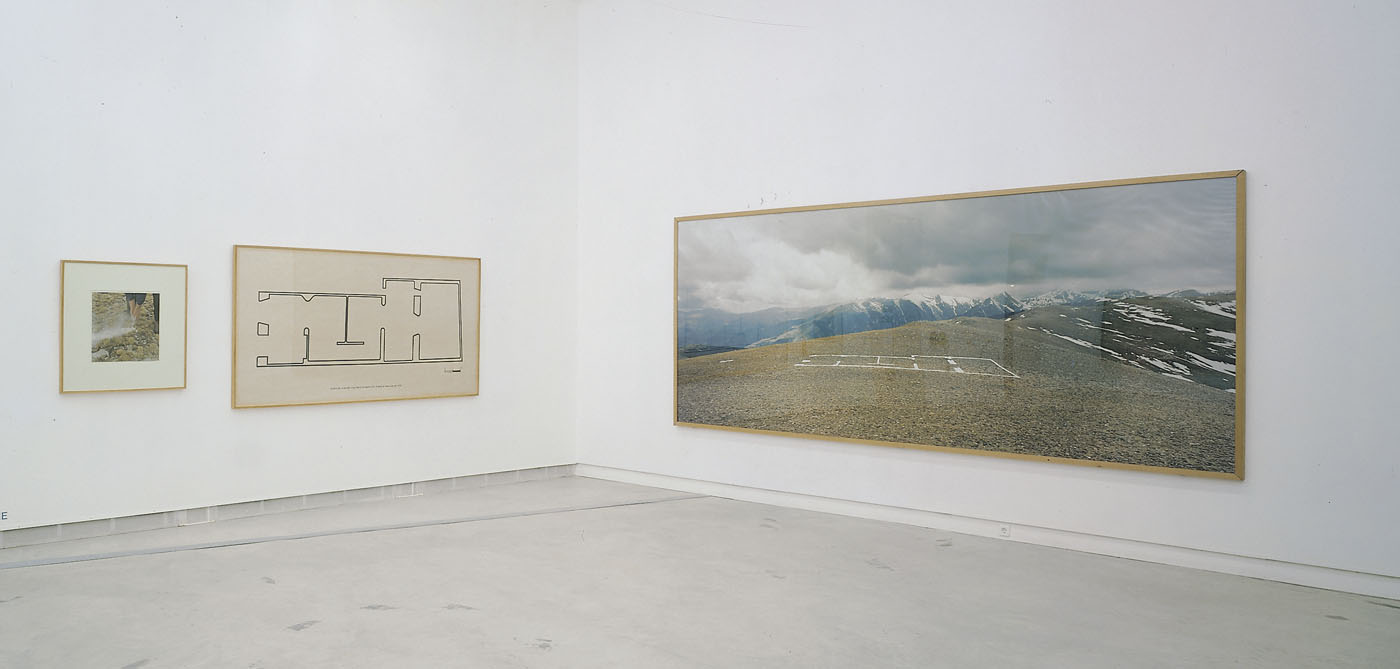
Fotografía Cibachrome en color de Glegg & Guttmann, 9 dibujos y 2 sillas de acero, masonita y yeso
Dimensions: 255 x 380 x 71 cm
Reference: ACF0658
Print sheet Print sheet Add to My Collection Add to My Collection
Within the body of the artist's work, Fish Must Swim provides a good opportunity to observe his intentions and plans concerning two fundamental aspects of his universe: a criticism of authorship (and style) and a reflection on the fact of "exhibiting". It has been frequently pointed out how difficult it is to categorise Franz West's work simply as sculpture or installation. That is due not so much to his visual formats or ideas but, most of all, to his elaborate network of relations and associations with that "other world", which seems to move far from the circles of experts and connoisseurs. West has a particular interest in dismantling the structures of perception, in higher or lower terms and according to the intellectual "level" of the spectator. There are many perceptions and West's work seems to show his intention to move between the two: "West addresses two types of audience: the 'connoisseur' audience that is capable of appreciating the conceptual strategies in the history of art itself, and that audience which, though not incapable of recognising the works as art, simply enjoys their utilitarian properties". Those aspects of the "unconscious" in fact refer to the artist's own interest in two of the most influential Austrian intellectuals of the last century: Sigmund Freud and Ludwig Wittgenstein. Thus, in Fish Must Swim we find ourselves faced with a set of pictorial, photographic and object elements which make up a particular frontal scene. They all seem to get round the lack of a predominant style which might serve as a common binding agent or a collocation strategy which might provide clear clues to a reading. West's work forces the spectator to wonder about the visual hierarchies of exhibitions adopted by curators and the meaning of the location of different pieces, apparently unconnected with one another. Nevertheless, we can appreciate references to the modern tradition of that very criticism (Joseph Kosuth and the chairs), or the art world's interest in the identification of the author. In that case, the incorporation of a photograph taken by the artists Glegg & Guttman is not accidental insofar as West wants to free the piece from the univocal presence of the author's hand. In many of his works, the artist has worked with other creators or art students who have not yet become established.

Works that may interest you