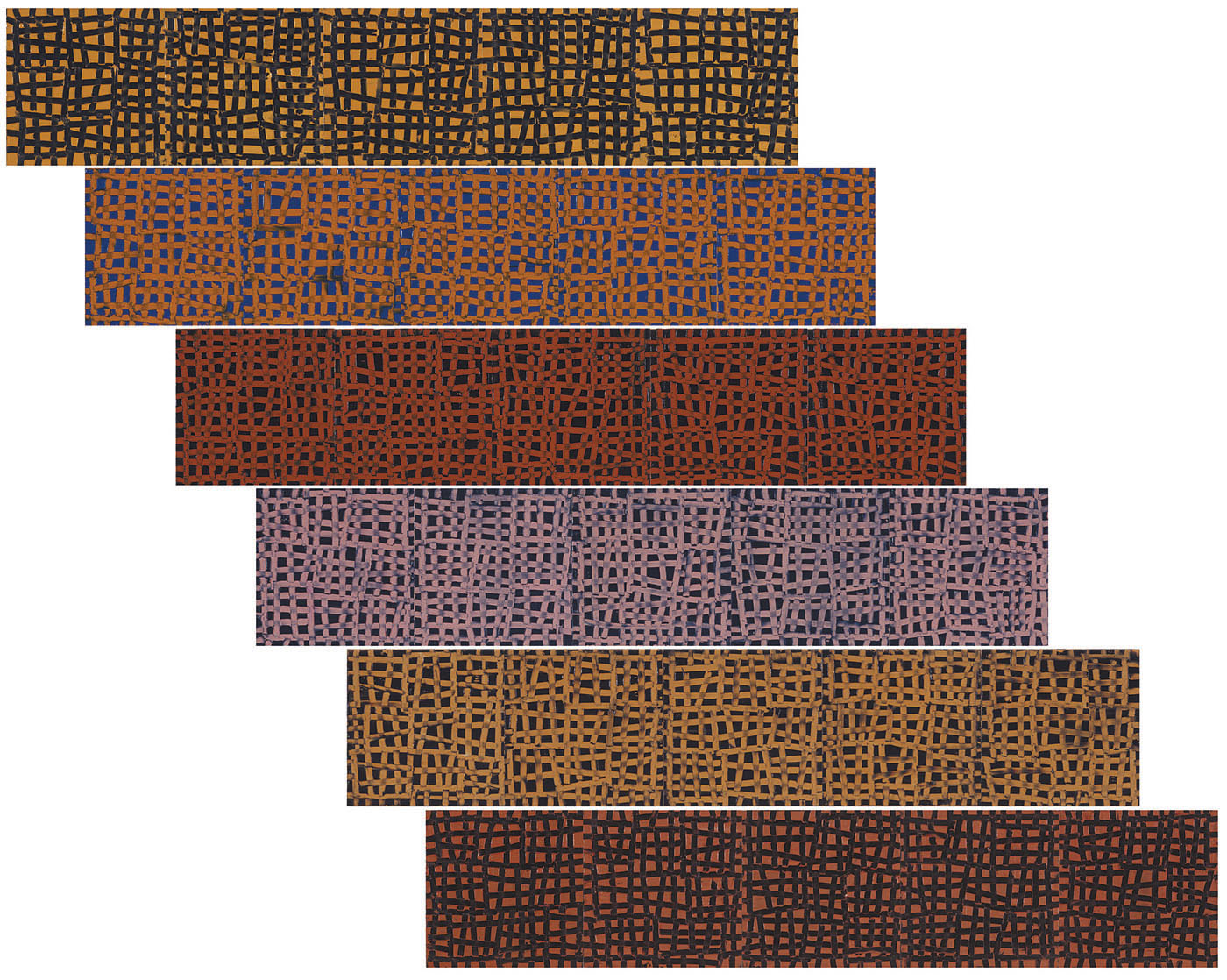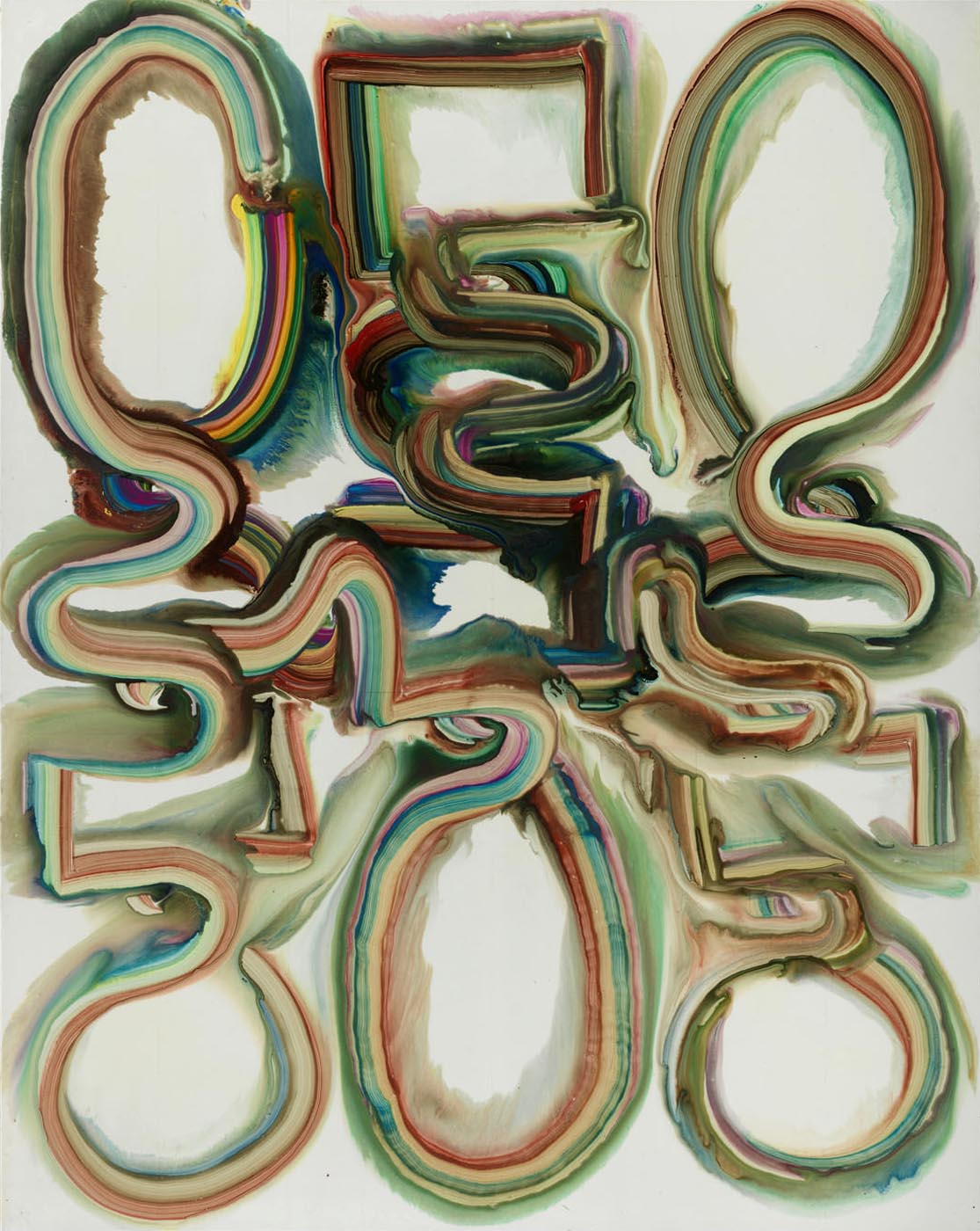
To paint Taunus, Bernard Frize used a tool consisting of six brushes which he made himself. With it he applied a single, but multiple, brushstroke, obtaining a composition made up of serpentine lines that criss-cross and create circles, ovals and squares. The composition is markedly Baroque and the work does not contain any recognisable motif, only the brushstroke that winds its way across the whole surface. For Frize painting is only the result of the method he has chosen to use in each case; the content of the work is the process of execution itself, a process that forms the structure of the image. To achieve that, he tries to draw the spectator away from learned interpretations and associations when reading his work; he invites us not to look, but to reconstruct the act of painting. The single gesture and the uninterrupted line make us try to follow the trace of the brush. We can see how the lines cross one another and the colours mix and discover the spatial decisions the artist has taken when doing the painting, thus reconstructing the tempo of the picture. For Frize, “a work must be able to supply information about how it is done, thus making the spectator part of the process and weaning him away from the passive attitudes that are typical of the history of painting.” That interest in subverting the characteristics of heroic and narrative painting, so typical of the eighties, and obtaining a kind of expressive neutrality also affects the choice of colour. Although Taunus is composed of various tones, none of them predominates over the others, and the choice has been completely arbitrary. To finalise the process Frize applies a layer of resin which erases any possibility of interpretation of the texture. With that he endows the compositions with a fine, shiny surface, closer to a photographic image than a painting: a cold, objective result which nevertheless enables a subjective reconstruction of the process of obtaining the image. Frize's painting is a kind of deconstruction of the very act of painting, in such a way that it lays bare its artificiality.